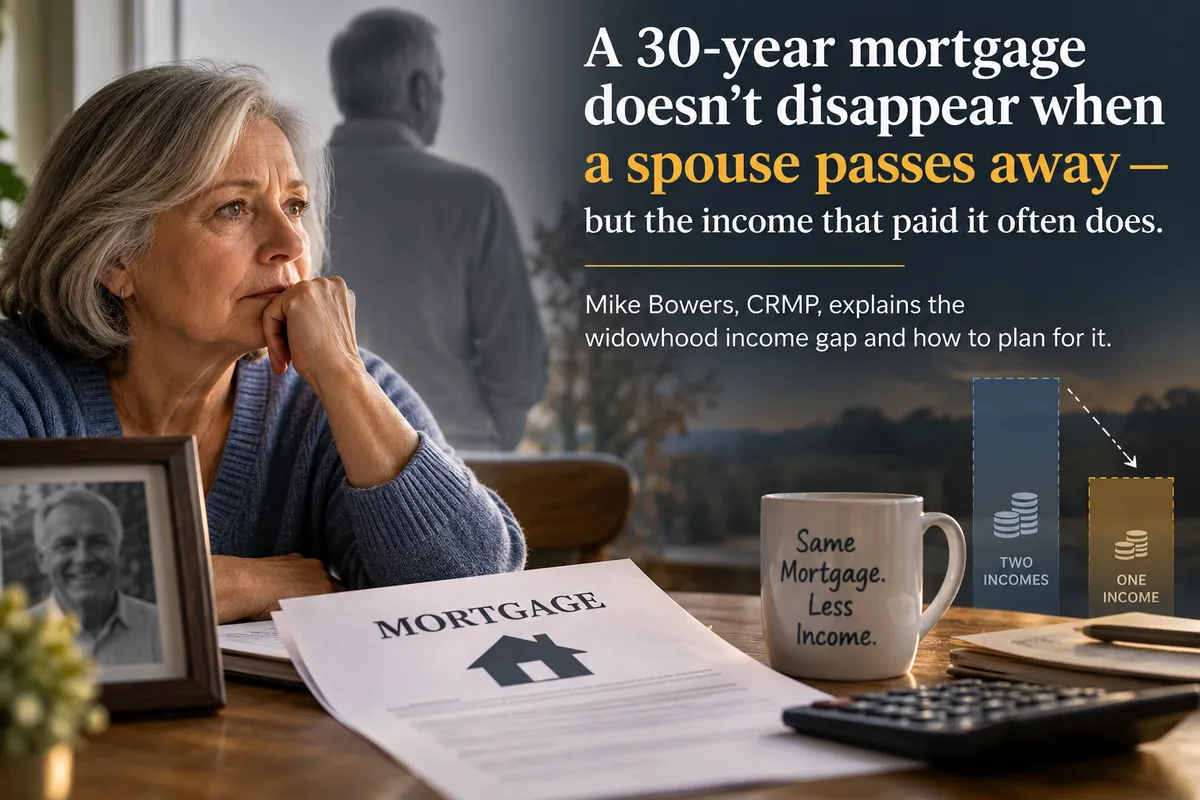
What Happens to Your Mortgage When One Spouse Passes Away? The Conversation Most Couples Never Have
Here's a question I ask couples in their 70s that almost no one has asked them before:
“When one of you is gone, can the survivor still make the mortgage payment alone?”
It's an uncomfortable question. It's also one of the most important ones in retirement planning — and it's almost never addressed in a standard financial plan.
The Numbers Behind the Question
The average period of widowhood lasts 8 to 12 years. Statistically, women outlive their husbands more often than not.
When a spouse passes away, household income typically drops — often by the loss of one Social Security check and sometimes a pension as well. What doesn't drop is a mortgage payment, if there's a traditional 30-year loan still on the home.
I've sat across the table from couples buying a “right-sized” home in their early-to-mid 70s, financing it with a conventional 30-year mortgage, without ever running that scenario forward. When I show them the actual cash flow the surviving spouse would face, the room changes. It's not a comfortable moment — but it's a necessary discussion.
A Different Way to Purchase
For homeowners 62 and older, a HECM for Purchase — what I call a Lifestyle Home Loan — offers a different path. It allows a homeowner to put down roughly 45-60% of the purchase price and never have a mandatory monthly mortgage payment for as long as they live in the home and meet loan obligations.
That means if one spouse passes away, the survivor isn't also trying to cover a $3,000-$4,000 monthly mortgage payment on a single income. They're grieving — not also facing a housing crisis on top of it.
Why This Belongs in Every Retirement Conversation
This isn't about pessimism. It's about honest planning. A retirement plan that only works while both spouses are alive isn't a complete plan — it's half of one.
Questions worth asking before a home purchase in retirement:
What percentage of our household income would disappear if one of us passed away first?
Could the survivor cover housing costs alone, indefinitely?
Does our home purchase strategy protect both spouses individually, not just as a couple?
Frequently Asked Questions
Does a HECM go away when one spouse passes away?
No. As long as a surviving spouse is a co-borrower (or qualifies as an eligible non-borrowing spouse under HUD guidelines) and continues to meet loan obligations, they can remain in the home.
Can heirs inherit a home with a HECM balance?
Yes. Heirs can sell the home and keep any remaining equity, or pay off the loan balance to keep the home.
Is this only for people who can't afford a traditional mortgage?
No — many clients I work with could qualify for a conventional mortgage. They choose a Lifestyle Home Loan specifically to protect a surviving spouse and preserve investment assets.
Have You Run This Number for Your Own Home?
If you're planning a home purchase or already carrying a mortgage into your 70s, it's worth running the widowhood scenario before it becomes reality instead of after.
Mike Bowers, CRMP
HECM Housing Wealth Advisor | Tri-State Branch Manager
Mutual of Omaha Mortgage | NMLS# 61535
(513) 680-6168 | [email protected]
4555 Lake Forest Dr, Suite 650, Cincinnati, OH 45242
This material is not from HUD or FHA and has not been approved by HUD or any government agency.
