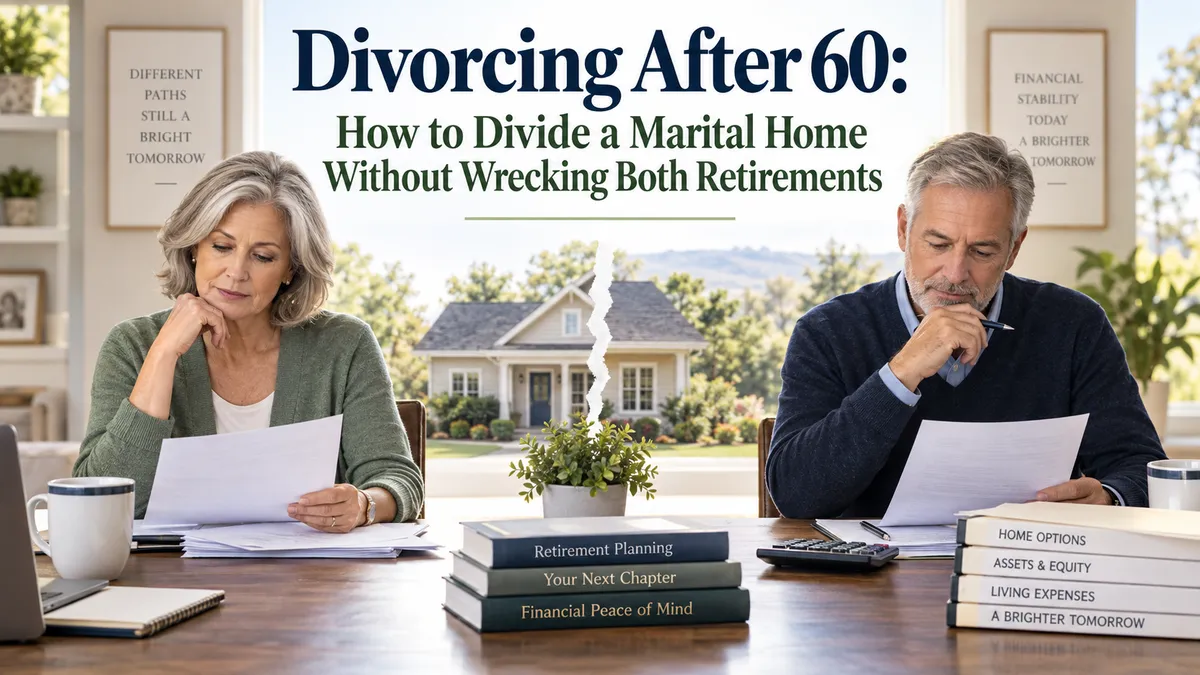
Divorcing After 60: How to Divide a Marital Home Without Wrecking Both Retirements
Divorce later in life — often called “gray divorce” — is becoming more common among couples in their 60s, 70s, and beyond. Financially, it creates a problem younger divorcing couples don't usually face: two people who were planning to retire on one household's worth of housing and income now need two households, funded by the same retirement resources.
Traditionally, one spouse buys out the other's share of the home, or the home is sold and the equity is split. Either path often forces one or both spouses to scramble for new housing resources at exactly the moment their portfolio can least afford it.
The Core Problem
When a marital home is sold or divided, both departing spouses typically need to acquire new, comparable housing — often at the same time, often in the same market, often while both are drawing down the same finite pool of retirement assets.
Forced sales, rushed timelines, and mortgage payments layered onto fixed incomes can turn an already difficult transition into a lasting financial setback for both parties.
Two Strategies That Can Help
For homeowners 62 and older who qualify, a HECM for Purchase (H4P) — a Lifestyle Home Loan used to buy a new home — can restore options on both sides of the split.
Solution 1: A HECM for Purchase on the departing spouse's new home
●Provides funds toward a down payment on a new home
●Pays the rest of the purchase price, with no monthly mortgage payment required
●No forced sale of the marital home, and no debt-service obligation for either spouse
Solution 2: A HECM for Purchase for the spouse remaining in the marital home
●The remaining spouse keeps the marital home
●The departing spouse uses their share of equity, combined with a HECM for Purchase, to acquire a new equivalent home
●Both spouses retain the chance of comparable housing value, without one being forced into a downgrade
Why This Matters for the Whole Retirement Plan
A divorce settlement that technically “splits things evenly” can still leave one or both spouses financing a mortgage payment deep into retirement — undermining the very security the original plan was built around. Housing arrangements that avoid new mortgage obligations for both spouses can enhance retirement income security for each, without requiring either one to draw down their portfolio just to have a place to live.
Frequently Asked Questions
Can both divorcing spouses use a HECM for Purchase separately?
Yes, provided each meets HECM eligibility requirements independently, including being 62 or older and able to cover ongoing property taxes, insurance, and maintenance on their new home.
Does this avoid selling the marital home?
It can. Depending on the settlement, one spouse may keep the marital home while the other uses a HECM for Purchase to acquire separate housing, avoiding a forced sale altogether.
Is this only useful in divorce situations?
No — the same HECM for Purchase strategy is commonly used by retirees relocating, downsizing, or moving closer to family, without a gray divorce involved.
Navigating a Difficult Transition
If you or someone you know is facing a divorce later in life and worried about what happens to the family home, it's worth understanding all the options before assuming a forced sale is the only path forward.
Mike Bowers, CRMP
HECM Housing Wealth Advisor | Tri-State Branch Manager
Mutual of Omaha Mortgage | NMLS# 61535
(513) 680-6168|[email protected]
4555 Lake Forest Dr, Suite 650, Cincinnati, OH 45242
This material is not from HUD or FHA and has not been approved by HUD or any government agency.
