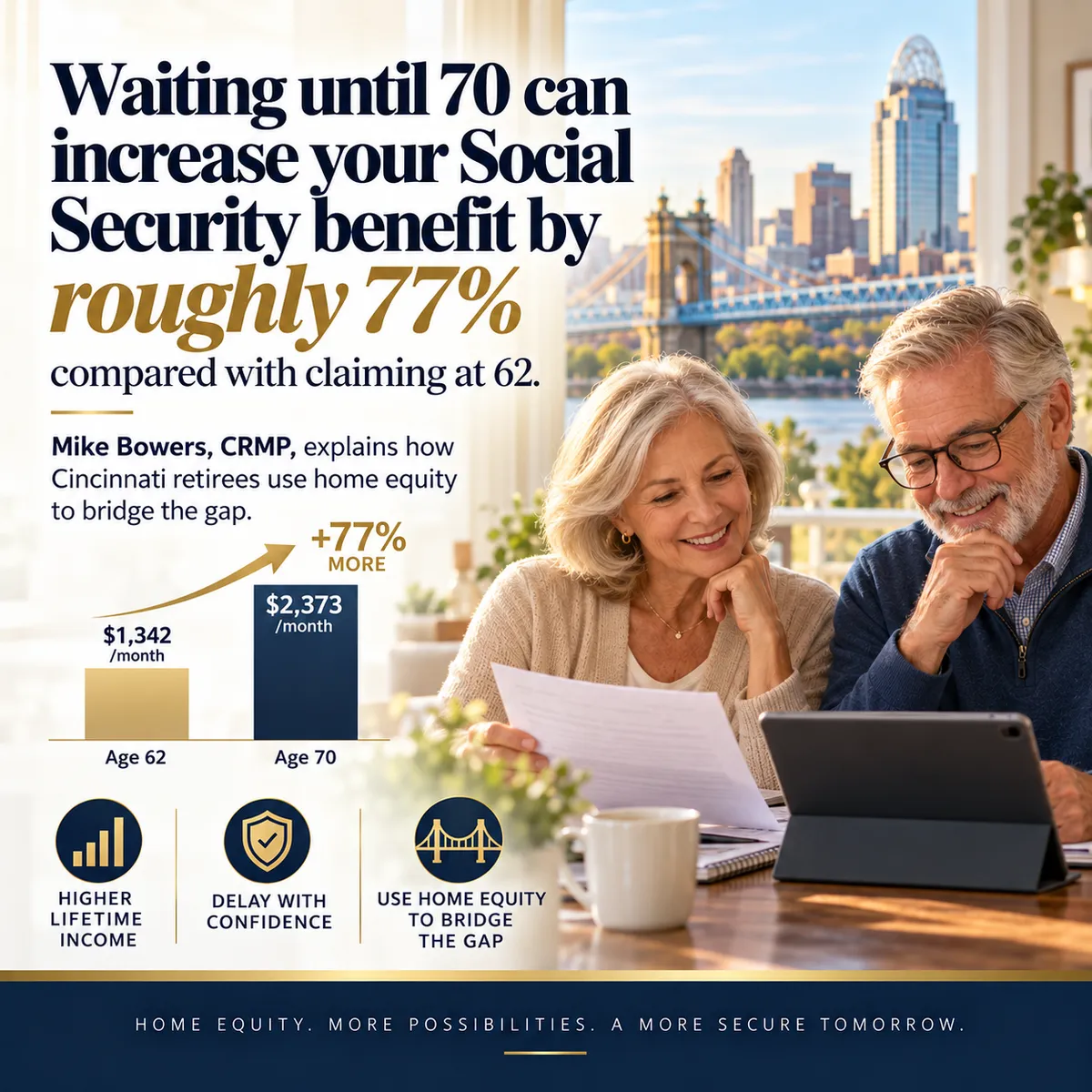
Should You Delay Social Security? How a Lifestyle Home Loan Can Bridge the Gap to Age 70
Here's a question I ask almost every couple who sits at my desk in Cincinnati:
"If you could get a raise of about 8% a year, guaranteed and adjusted for inflation, for the rest of your life, would you take it?"
Everyone says yes.
That's roughly what you get for each year you delay Social Security past full retirement age, up to age 70. The problem is that most people can't afford to wait.
The Social Security Timing Problem
You can claim Social Security as early as 62. But if your full retirement age is 67, claiming at 62 locks you into about 70% of your full benefit for life. If you wait until 70, you receive about 124%.
That's a difference of roughly 77% in monthly income, and it lasts as long as you live. If you're married, it can also mean a larger survivor benefit for the spouse who outlives the other.
So why do so many people claim early? They need the income now. The paycheck stops at 62 or 65, the bills don't, and waiting until 70 feels impossible.
Using Home Equity as a Bridge
This is where a Lifestyle Home Loan (HECM) can play a strategic role. Instead of claiming Social Security early, or drawing heavily from investment accounts, some retirees use home equity to cover living expenses for the years between retirement and age 70.
A HECM can provide:
Monthly payments to replace income during the "bridge" years
A line of credit to draw from as needed
Elimination of an existing mortgage payment, which lowers what you need each month
Proceeds from a HECM are loan funds, not income. They generally aren't taxable and don't affect Social Security or Medicare benefits. (Please check with your tax advisor about your situation.)
The Longevity Math
We're living longer. A healthy 65-year-old couple today has a good chance that at least one of them reaches 90.
That's the core of longevity planning. The longer you live, the more a larger, inflation-adjusted Social Security check is worth. Delaying benefits is one of the few ways to buy more guaranteed lifetime income, and using home equity to fund the wait can turn a house into a long-term retirement asset.
A Bigger Strategy: Taxes and Required Distributions
For some clients, the bridge strategy goes further. Delaying Social Security can create lower-income years between retirement and the start of Required Minimum Distributions. Those years can be a window for converting traditional IRA money to a Roth IRA at lower tax rates.
One illustrative case: a 67-year-old couple bought a new home using a HECM for Purchase. They made no monthly mortgage payments for five years, delayed Social Security, and let their investments grow. Later, they made a large voluntary interest payment, which can be deductible in some situations, in the same year as a partial Roth conversion. The deduction helped offset the extra taxable income.
Strategies like this must be coordinated with a CPA and financial advisor. Tax treatment depends on how the loan is structured and on your circumstances. But it shows what's possible when home equity becomes part of the plan instead of being left idle.
Who Should Consider This Strategy?
It's worth exploring if you:
Are 62 or older and own a home with significant equity in the Cincinnati or Northern Kentucky area
Are in good health and expect a long retirement
Are married and want to maximize the survivor benefit
Want to avoid drawing down investments in the early years of retirement
Frequently Asked Questions
Q: How much more Social Security do I get if I wait until 70?
For someone with a full retirement age of 67, benefits at 70 are about 124% of the full amount. At 62, they're about 70%, so waiting increases the monthly check by roughly 77%.
Q: Can a reverse mortgage help me delay Social Security?
Yes. HECM proceeds can cover living expenses while you wait to claim, which lets your benefit grow until age 70.
Q: Are reverse mortgage proceeds taxable?
HECM proceeds are loan funds and are generally not considered taxable income. Consult a tax advisor about your situation.
Q: Does a reverse mortgage affect Social Security or Medicare?
No. HECM proceeds don't affect Social Security or Medicare. They can affect needs-based programs such as Medicaid or SSI.
Want to run the numbers on your Social Security timing? Bring your benefit statement, and I'll bring the coffee. Call (513) 680-6168 or email [email protected].
Mike Bowers, CRMP
HECM Housing Wealth Advisor | Mutual of Omaha Mortgage | NMLS# 61535
4555 Lake Forest Dr, Suite 650, Cincinnati, OH 45242
(513) 680-6168 | [email protected] | michaelbowerscrmp.com
